
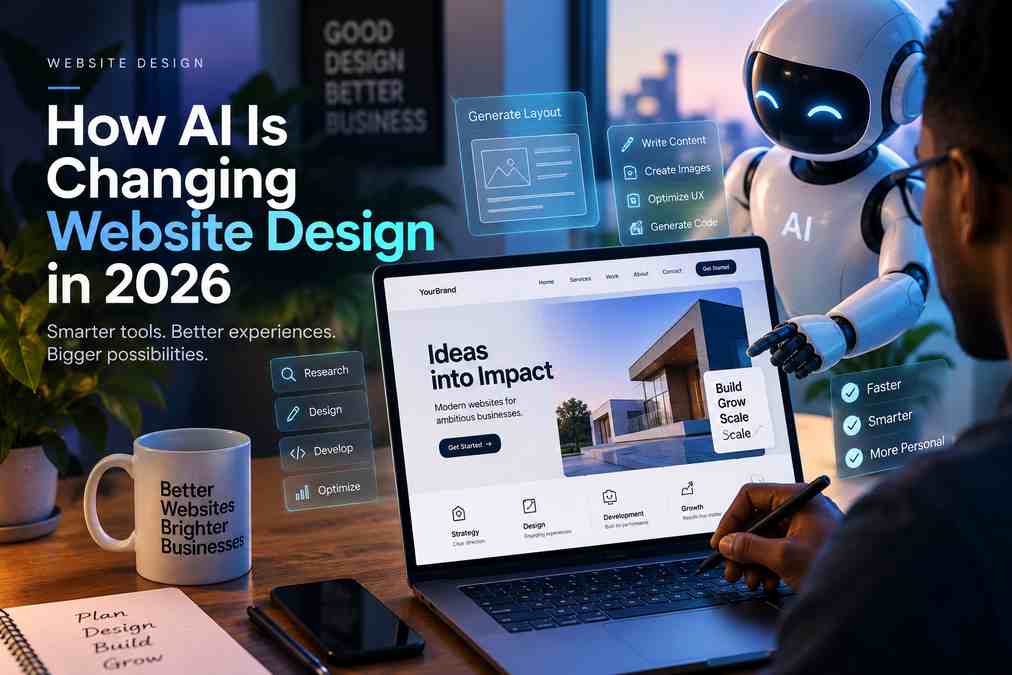
How AI Is Changing Website Design in 2026
Nnamdi A.
Website design is no longer just about choosing the right colours, arranging sections, and making sure a website looks good on mobile.
In 2026, artificial intelligence is changing almost every stage of the website design process; from research and wireframing to content creation, development, personalization, testing, and optimization.
AI can now help businesses generate layouts, write and refine website content, create visual assets, analyse user behaviour, identify usability problems, generate code, and personalize digital experiences at scale.
But there is an important distinction: AI is changing website design, not eliminating the need for good website design.
The businesses that benefit most from AI are not necessarily those that automate everything. They are the ones that combine AI's speed and capabilities with human strategy, creativity, brand understanding, and user experience expertise.
So, what exactly is changing?
1. AI Is Making Website Planning Faster
Before a website is designed, there is usually a significant amount of research involved.
Designers and developers need to understand:
- Who the target audience is
- What users are looking for
- What competitors are doing
- What pages the website needs
- How users should move through the website
- What actions visitors should take
- What content needs to be created
AI can accelerate much of this early-stage work.
Instead of starting with a blank document, designers can use AI to generate initial sitemap ideas, user journeys, content structures, page recommendations, and design concepts based on a business's objectives.
For example, a company launching a B2B technology service could use AI to help structure a website around:
Homepage → Solutions → Industries → Case Studies → Resources → About → Contact
The designer can then refine that structure based on the company's actual customers, sales process, brand and business goals.
The result is not necessarily a fully automated website. Instead, AI becomes a strategic starting point that helps teams move from an idea to a workable structure faster.
2. AI Is Changing How Website Layouts Are Created
One of the most visible changes is the ability to generate website layouts using natural-language instructions.
Instead of manually creating every section from scratch, designers can describe what they want.
For example:
"Create a modern website homepage for a Nigerian technology company. The website should target enterprise decision-makers, communicate trust and technical expertise, highlight three core solutions and include strong calls to action."
AI-powered design and website-building tools can turn that instruction into an initial interface or page structure.
This can significantly reduce the time required to produce early concepts.
However, generated layouts still need human review.
AI may produce a visually attractive page that doesn't necessarily reflect:
- The company's brand
- The customer's actual needs
- The sales journey
- Accessibility requirements
- Local cultural context
- Conversion objectives
The designer's role therefore shifts from simply creating every element manually to directing, evaluating and improving AI-generated work.
3. AI Is Making Website Development More Accessible
Website development is also being affected by AI.
Developers can now use AI assistants to generate code, explain unfamiliar code, identify bugs, create components, write documentation and speed up repetitive development tasks.
This doesn't mean that developers are becoming unnecessary.
Instead, AI can remove some of the repetitive work that previously consumed development time.
A developer might use AI to generate the first version of a component and then focus their attention on:
- Architecture
- Security
- Performance
- Integrations
- Accessibility
- Testing
- Scalability
- Business logic
This can make development workflows considerably faster.
For businesses, that could translate into shorter development cycles and more opportunities to test and improve a website before launch.
4. Website Content Is Becoming More AI-Assisted
Content is one of the biggest areas where AI has already changed digital marketing.
Website teams can use AI to help develop:
- Headlines
- Product descriptions
- Landing-page copy
- FAQs
- Blog articles
- Calls to action
- Meta descriptions
- Email copy
- Content variations
But there is a major difference between AI-generated content and good website content.
Simply generating hundreds of pages with AI does not automatically create a better website.
Effective website content still needs:
- Original insights
- Brand personality
- Subject-matter expertise
- Clear positioning
- Evidence
- Customer understanding
- A strong reason for the visitor to take action
AI can help produce content faster, but businesses still need to provide the knowledge and perspective that make the content valuable.
5. Personalization Is Becoming More Intelligent
Traditionally, many websites showed essentially the same experience to every visitor.
AI is making it possible to create more personalized digital experiences.
For example, a website could potentially adapt its content based on signals such as:
- The visitor's industry
- Their previous interactions
- The pages they viewed
- Their stage in the buying journey
- Their interests
- Their location
- Their previous engagement
A visitor interested in enterprise data solutions could see different messaging from someone researching entry-level training programs.
The goal is not simply to make a website "smart."
The goal is to make the website more relevant to the person using it.
When implemented properly, personalization can reduce friction and help visitors find the information they need more quickly.
6. AI Is Helping Websites Become More Conversational
Search boxes are no longer the only way users interact with websites.
AI-powered chat interfaces and conversational assistants are becoming increasingly common.
Instead of navigating through several pages to find an answer, a visitor could ask:
"Which solution is suitable for a bank with multiple branches?"
Or:
"How much does your service cost?"
Or:
"Can I book a consultation?"
An AI assistant can potentially help the visitor find relevant information and move them toward the next step.
For businesses, this creates an opportunity to turn a website from a digital brochure into an interactive sales and support channel.
However, conversational interfaces should complement good information architecture rather than replace it.
Visitors should still be able to navigate the website normally.
7. AI Is Changing Website Testing and Optimization
Launching a website is no longer the end of the design process.
The best websites are continuously tested and improved.
AI can help teams analyse large amounts of information from:
- Analytics
- Heatmaps
- Conversion data
- User behaviour
- Search data
- Customer feedback
- A/B tests
AI can help identify patterns that might otherwise take a human analyst considerably longer to discover.
For example, it might highlight that users frequently visit a pricing page but rarely proceed to the contact form.
That could lead the team to investigate:
Is the pricing unclear?
Is the CTA difficult to find?
Are users leaving because of the price?
Does the page need stronger proof or FAQs?
AI can surface the pattern. Human teams still need to determine the reason and decide what to change.
8. Accessibility Can Benefit From AI
Accessibility is another area where AI can support website teams.
AI-powered tools can help identify potential issues involving:
- Image descriptions
- Colour contrast
- Content readability
- Navigation
- Semantic structure
- Form labels
- Keyboard accessibility
This can make accessibility checks faster during the design and development process.
However, automated checks cannot replace comprehensive accessibility testing.
A website should still be evaluated against recognised accessibility standards and, where appropriate, tested with real users.
9. AI Is Changing What "Good Design" Means
Perhaps the biggest change is philosophical.
For years, website design was heavily focused on visual differentiation.
Businesses wanted websites that looked modern, impressive and different from competitors.
In 2026, the conversation is increasingly moving toward experience and outcomes.
A good website needs to answer questions such as:
- Can users find what they need quickly?
- Does the website communicate trust?
- Is the experience accessible?
- Does it work well on mobile?
- Is the content useful?
- Does it load efficiently?
- Does it support search visibility?
- Does it generate enquiries or sales?
- Can the experience adapt to different users?
AI makes it easier to produce visual concepts.
That means visual execution alone becomes less of a differentiator.
Strategy, positioning, UX, originality and execution become even more important.
10. AI Doesn't Replace Designers. It Changes Their Role.
One of the biggest misconceptions about AI in website design is that businesses can simply replace designers and developers with AI tools.
In reality, AI still needs direction.
Someone has to determine:
What should we build?
Who are we building it for?
What problem are we solving?
What should the visitor do next?
What should the brand feel like?
What information should we prioritise?
How will success be measured?
These are strategic questions.
AI can generate options, but choosing the right option requires context and judgement.
The designer of the future may therefore spend less time pushing pixels and more time directing systems, evaluating outputs, understanding users and solving business problems.
# The Risks of Using AI in Website Design
AI brings significant opportunities, but businesses should also understand its limitations.
Generic Design
AI can produce designs that look polished but feel remarkably similar to thousands of other AI-generated websites.
A website still needs a distinctive brand identity.
Inaccurate Information
AI-generated content can contain factual errors or make unsupported claims.
Business information should always be reviewed before publication.
Poor User Experience
A website can look impressive while still being difficult to use.
Visual quality does not automatically equal good UX.
Over-Automation
Automating every part of the design process can remove the human understanding that makes a website genuinely useful.
Privacy and Data Concerns
Businesses also need to understand how AI tools handle customer, business and website data before connecting them to sensitive systems.
# How Businesses Should Approach AI Website Design in 2026
The best approach isn't:
"Let's use AI to build our website."
A better question is:
"Where can AI help us build a better website, faster?"
A practical workflow could look like this:
Step 1: Define the business objective
Determine what the website needs to achieve.
Step 2: Understand the audience
Identify customer needs, pain points, questions and buying behaviour.
Step 3: Develop the strategy
Create the sitemap, messaging, positioning and user journeys.
Step 4: Use AI for exploration
Generate concepts, layouts, content ideas, code and variations.
Step 5: Apply human judgement
Review everything against the brand, audience and business objectives.
Step 6: Build and test
Develop the website and test performance, accessibility, usability and functionality.
Step 7: Measure
Track traffic, engagement, conversions and other relevant business metrics.
Step 8: Continuously improve
Use analytics, customer feedback and AI-assisted analysis to identify opportunities for improvement.
# What the AI-Powered Website of 2026 Looks Like
The website of 2026 isn't necessarily a website that looks like it was designed by AI.
It is a website where AI works behind the scenes to make the experience better.
It may:
- Understand what visitors are looking for
- Personalize relevant content
- Help users find information
- Assist customer support
- Generate and optimize content
- Identify UX problems
- Support developers
- Analyse performance
- Improve conversion opportunities
The most successful implementation of AI may therefore be the one visitors barely notice.
They simply experience a website that feels faster, more relevant, easier to use and more helpful.
# Final Thoughts
AI is changing website design in 2026 by making many parts of the process faster, more accessible and increasingly data-driven.
But AI isn't the strategy.
It isn't the brand.
And it doesn't automatically understand your customers.
The strongest websites will combine AI's speed and analytical capabilities with human creativity, strategy, empathy and experience.
For businesses planning a new website or redesign in 2026, the question shouldn't simply be whether AI should be used.
The more important question is:
How can we use AI to create a website that delivers a better experience for our customers and better results for our business?
That is where the real opportunity lies.